Moroccan Words for Travelers: Basic Darija Phrases You Should Know
Which Moroccan words do you need when traveling in Morocco? With about 30 words of Darija, the Arabic spoken on the street in Morocco, you can greet people, order mint tea, ask a price, bargain with a smile and ask for help. You do not need to speak well. Moroccans appreciate it when travelers try, and a simple “shukran” (thank you) opens many doors.
This guide gives you the most useful phrases, written the way they sound in English, so you can read them out loud without stress. They are grouped by situation: greetings, numbers, food, shopping, directions, the desert and emergencies.
What Language Do They Speak in Morocco?
Several languages live side by side in Morocco, which surprises many visitors:
- Darija (Moroccan Arabic): the everyday language of streets, markets and taxis. It is different from the classical Arabic of books and TV news.
- Classical Arabic and Amazigh (Tamazight): both are official languages. Amazigh is widely spoken in the Atlas Mountains and in the south, including the Merzouga area.
- French: widely used in hotels, restaurants, administration and business.
- English and Spanish: understood in tourist areas, and Spanish is common in the north (Tangier, Tetouan, Chefchaouen).
You can get by with English in most tourist places, and many desert guides speak several languages. Even so, a few words of Darija change the way people treat you.
Greetings and Politeness in Darija
Greetings matter a lot in Morocco. People greet first before asking or ordering anything, and greetings are often stretched with several questions about how you are.
| English | Darija (how it sounds) |
|---|---|
| Hello (peace be upon you) | Salam alaikum |
| Reply to the greeting | Wa alaikum salam |
| How are you? | Labas? |
| Fine, thank God | Labas, alhamdulillah |
| Good morning | Sbah el-jer |
| Good afternoon / evening | Msa el-jer |
| Welcome | Marhba |
| Thank you | Shukran |
| Thank you very much | Shukran bzaf |
| Please | Afak |
| Excuse me / sorry | Smahli |
| Goodbye | Beslama |
Tip: “bzaf” means “a lot” and you will hear it all the time. To impress people, add “bzaf” to your “shukran”.
Basic Everyday Words
| English | Darija (how it sounds) |
|---|---|
| Yes | Iyeh / Naam |
| No | La |
| OK, all right | Wakha |
| No problem | Mashi mushkil |
| No thank you | La, shukran |
| I want… | Bghit… |
| I don’t understand | Ma fhemtsh |
| Slowly | Bshwiya |
| A lot | Bzaf |
| A little | Shwiya |
| Here / there | Hna / Temma |
“Wakha” is probably the most useful word of all. It works for accepting a plan, confirming a time or closing a deal.
Numbers in Darija
Knowing how to count helps you understand prices, times and distances. Here are the numbers from 1 to 10 and a few round numbers:
| Number | Darija (how it sounds) |
|---|---|
| 1 | Wahed |
| 2 | Tnin / Juj |
| 3 | Tlata |
| 4 | Arbaa |
| 5 | Jamsa |
| 6 | Sitta |
| 7 | Sebaa |
| 8 | Tmenya |
| 9 | Tisaa |
| 10 | Ashra |
| 20 | Ashrin |
| 100 | Mia |
Prices are in dirhams. If a seller just says a number, they almost always mean dirhams. Ask them to repeat it or type it on a phone if you are unsure.
Words for Eating and Drinking
| English | Darija (how it sounds) |
|---|---|
| Water | Ma |
| Tea (mint tea) | Atay |
| Coffee | Qahwa |
| Bread | Khobz |
| Meat | Lham |
| Chicken | Djaj |
| Fish | Hut |
| Vegetables | Khodra |
| Without sugar | Bla sukar |
| Without meat | Bla lham |
| Delicious | Bnin |
| The bill, please | L-hisab, afak |
Dishes you will see on almost every menu: tagine (slow-cooked stew in a clay pot), couscous (traditional on Fridays), harira (tomato and legume soup) and pastilla (sweet and savory pastry). If you are vegetarian, say “ana nabati, bla lham” (I am vegetarian, no meat) and ask for a vegetable tagine.
After a meal or a haircut you will often hear “saha”, which means “to your health”. You can answer “allah ibarek fik” (God bless you) or simply “shukran”.
Phrases for Shopping and Bargaining in the Souk
In the souks, bargaining is part of the purchase. It is done with humor and without hurry, and it should never feel like a fight.
| English | Darija (how it sounds) |
|---|---|
| How much? | Bshal? |
| It is very expensive | Ghali bzaf |
| Lower the price a little | Nqas shwiya |
| I’m just looking | Ghir kanshuf |
| No, thank you | La, shukran |
| Last price | Akhir taman |
| I’ll take it | Ghadi ndiha |
- Ask “bshal?” and answer with half the first price or less. Go up slowly.
- Smile and accept a tea if it is offered. It does not oblige you to buy.
- If you don’t want to buy, a polite “la, shukran” is enough.
- Don’t start bargaining if you have no intention of buying.
- Fixed-price shops, supermarkets and restaurants are not bargained.
Directions and Transport
| English | Darija (how it sounds) |
|---|---|
| Where is…? | Fin kayn…? |
| Right | Limen |
| Left | Lisar |
| Straight ahead | Nishan |
| Stop here, please | Wqef hna, afak |
| Taxi | Taxi |
| Train station | Mahatat el-qitar |
| Airport | El-matar |
| Hotel | Otel |
| Far / near | B3id / Qrib |
In city petit taxis, always ask the driver to use the meter (“compteur” in French, which everyone understands). For big taxis or long trips, agree the price before you get in.
Useful Words in the Merzouga Desert
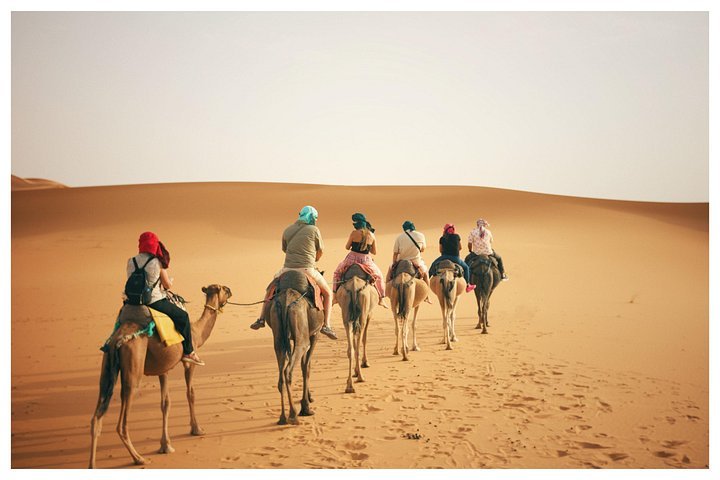
If you plan a night in the Sahara, these words will come with you. Around Merzouga and Erg Chebbi you will also hear Amazigh, and guides are glad when you show interest.
| English | How it sounds |
|---|---|
| Desert | Sahra |
| Dunes / sand | Remel |
| Camel | Jmel |
| Tent | Jayma |
| Oasis | Waha |
| Stars | Njum |
| Hello (in Amazigh) | Azul |
| Thank you (in Amazigh) | Tanmirt |
Saying “azul” to a guide or a camel handler often brings an instant smile. Planning your night in the dunes? Read about our desert camp and camel ride in Merzouga.
Moroccan Expressions You Will Hear All the Time
- Inshallah: “God willing”. Used when talking about the future. An answer of “inshallah” to an appointment is not always a firm yes, so confirm important times.
- Alhamdulillah: “thank God”. The usual answer to “how are you?”.
- Bismillah: “in the name of God”. Said before eating or starting something, and also to invite you to eat: “bismillah”.
- Yallah: “let’s go”. Very handy when the group is ready to leave.
- Safi: “that’s it, enough”. Used to end a conversation or say “that’s enough for me”.
- Mashi mushkil: “no problem”. Reassuring and used a lot.
Emergencies and Health
| English | Darija (how it sounds) |
|---|---|
| Help! | Awnuni! |
| I need a doctor | Bghit tbib |
| Hospital | Sbitar |
| Pharmacy | Saydaliya |
| Police | Shurta |
| I am sick | Ana mrid |
| It hurts here | Kayweje3ni hna |
The usual emergency numbers in Morocco are 19 (city police), 177 (Royal Gendarmerie in rural areas) and 15 (ambulance and civil protection). Check them before you travel in case they have changed, and keep them next to your insurance and embassy numbers.
Tips for Pronouncing and Using Darija
- The “j” in these spellings sounds like the soft French “j” (as in “measure”).
- “kh” and “gh” are throat sounds. It doesn’t matter if they aren’t perfect.
- English spellings of Darija vary by source. What matters is being understood.
- Use your right hand to greet, and to give or receive food and tea.
- Placing your hand on your heart after a handshake is a much-appreciated gesture.
- Download Arabic in your phone translator so you can use it offline.
The 10 Words You Must Learn
- Salam alaikum: hello
- Labas?: how are you?
- Shukran: thank you
- Afak: please
- Iyeh / La: yes / no
- Wakha: OK
- Bshal?: how much?
- Mashi mushkil: no problem
- Smahli: sorry
- Beslama: goodbye
Frequently Asked Questions
Is English spoken in Morocco?
Yes, in hotels, tourist restaurants and most tours. Outside tourist areas French and Darija are more common, so a few Darija words are very helpful.
Is Darija the same as Arabic?
Not exactly. Darija is the Moroccan dialect of Arabic, with many words from Amazigh, French and Spanish. A traveler who knows classical Arabic may find it hard to follow at first.
What does “shukran bzaf” mean?
It means “thank you very much”. “Shukran” is “thank you” and “bzaf” is “a lot”.
How do you answer “salam alaikum”?
You answer “wa alaikum salam”, which means “and peace be upon you too”.
What language is spoken in the Merzouga desert?
People speak Darija and Amazigh, and French, English and Spanish are common in tourism. Guides usually adapt to the language of the group.
Should I always bargain?
In souks, handicraft shops and taxis without a meter, yes. In restaurants, supermarkets, fixed-price shops and tours with a set price, no.
Keep Planning Your Trip to Morocco
Is it your first trip? Read which destination to choose on your first time in Morocco.
Want to practice your Darija in the Sahara? Message us on WhatsApp at +212 620 628 083 or use our contact page and we will help you plan your camel ride, your night at the desert camp or your desert tour.